CBSE Class 10 Maths Syllabus 2026-27: All 14 Chapters, Unit-wise Marks and How to Use Them
GyanSanchar · 17 Nov 2026
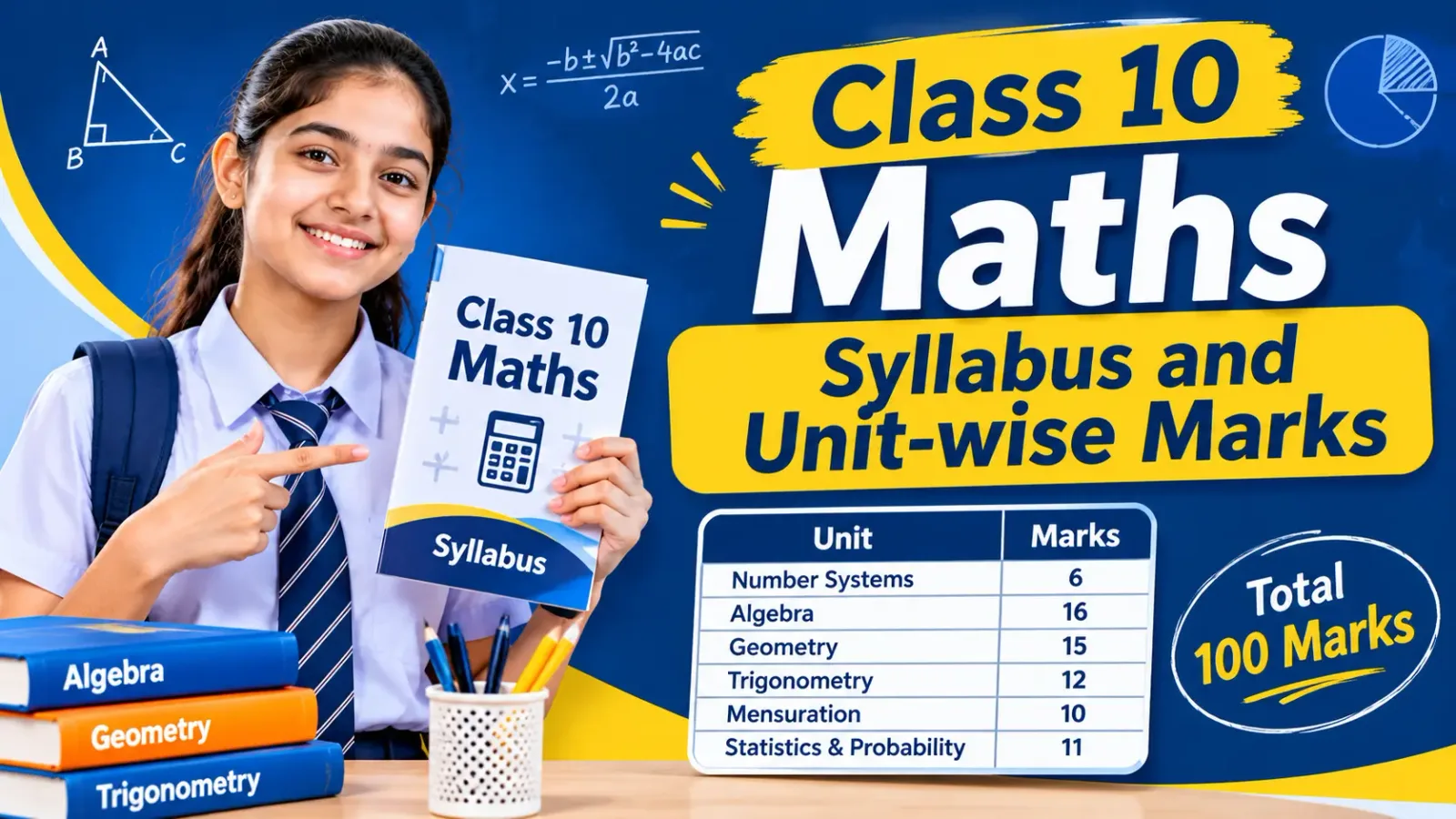
Before you open a single question paper, it helps to know what the Class 10 Maths course actually contains and how marks are spread over it. The CBSE Class 10 Mathematics paper is for 80 marks, and the school awards another 20 marks for internal assessment. The 80 marks come from seven units that hold fourteen chapters in all.
The unit-wise marks below follow the CBSE syllabus in use for the current cycle. Always confirm them against the latest syllabus document on cbseacademic.nic.in, because CBSE can revise the scheme.
Chapters and marks at a glance
Unit | Chapters | Marks | Share of the paper |
|---|---|---|---|
Number Systems | Real Numbers | 6 | 7.5% |
Algebra | Polynomials; Pair of Linear Equations in Two Variables; Quadratic Equations; Arithmetic Progressions | 20 | 25% |
Coordinate Geometry | Coordinate Geometry | 6 | 7.5% |
Geometry | Triangles; Circles | 15 | 18.75% |
Trigonometry | Introduction to Trigonometry; Some Applications of Trigonometry | 12 | 15% |
Mensuration | Areas Related to Circles; Surface Areas and Volumes | 10 | 12.5% |
Statistics and Probability | Statistics; Probability | 11 | 13.75% |
Total | 14 chapters | 80 | 100% |
What the table tells you
Algebra alone is a quarter of the paper. Four chapters, twenty marks. A student who is comfortable with quadratic equations and arithmetic progressions has already secured a large block of the paper. If you only have limited time in a week, algebra deserves the biggest slice.
Geometry and trigonometry together make 27 marks. These two units reward practice more than memory. A student who draws the figure carefully and writes each step usually does better here than one who tries to do it in the head.
Three small units add up. Real Numbers, Coordinate Geometry, and Statistics with Probability carry 23 marks between them. They have fewer ideas to learn than algebra or geometry, so they are a good place to collect marks early. We look at them in detail in a separate post on the 23 marks many students find easier.
How to turn the weightage into a plan
List all fourteen chapters and mark each one as strong, average or weak. Be honest, and base it on your last two tests rather than on how you feel.
Give study time in proportion to marks. If you study maths for five hours a week, about one and a quarter hours should go to algebra, about three-quarters of an hour to geometry, and so on down the table.
Add extra time for weak chapters, but only after the basics of the heavy units are in place. Spending a month on one 3-mark topic while quadratic equations is shaky is a poor trade.
Revise in the order of the table during the last month, so the heaviest units are fresh in your mind on exam day.
For a chapter-by-chapter plan, read our chapter-wise preparation strategy for Class 10 Maths, and when the exams get closer, follow the last 90 days revision plan.
Do not forget the 20 internal marks
The internal assessment is marked by your school and counts towards the final result. Keep your notebook neat, submit assignments on time and take school tests seriously. These marks are the easiest to protect and the hardest to recover later.
Want the whole syllabus in one place?
If you would like the full syllabus taught in order, with practice after each topic, take the Class 10 Mathematics (Do it Yourself) course from Gyan Sanchar. It is prepared and taught by Subhash Sir, An IITian with expertises in Physics and Mathematics, who has more than 15 years of experience teaching and mentoring students for JEE, NEET and board exams. It covers the chapters through chapter-wise video lectures, topic-wise practice questions, PDF practice sheets and online mock tests. You study at your own pace and keep access for life.